


Geology Bregaglia - rockslides
Natural hazards in mountainous areas
Although alpine glaciers have been receding since the peak of the last ice age 24,000 years ago, the last 150 years of global warming have caused unprecedented melting, as well as permafrost thawing and increased heavy precipitation. These changes mean that steep mountain slopes are increasingly prone to landslides and rockfalls. There is abundant evidence of large landslides in Bregaglia: in the town of Piuro, which was devastated by a rockfall in 1618; in the small village of Casaccia, where houses were partly buried by a landslide from Piz Lunghin in 1673; and in many side valleys, where the remains of prehistoric landslides can still be seen.
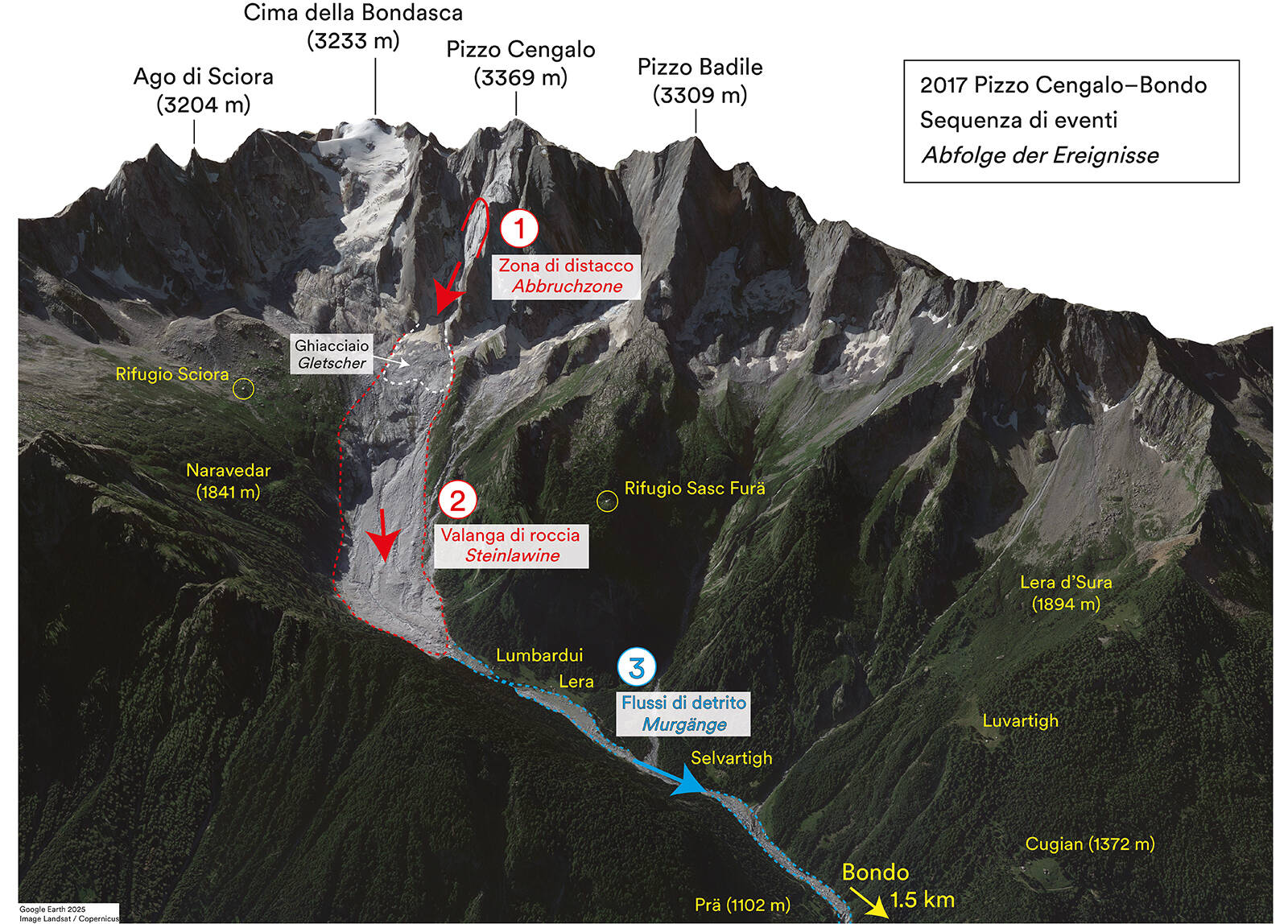
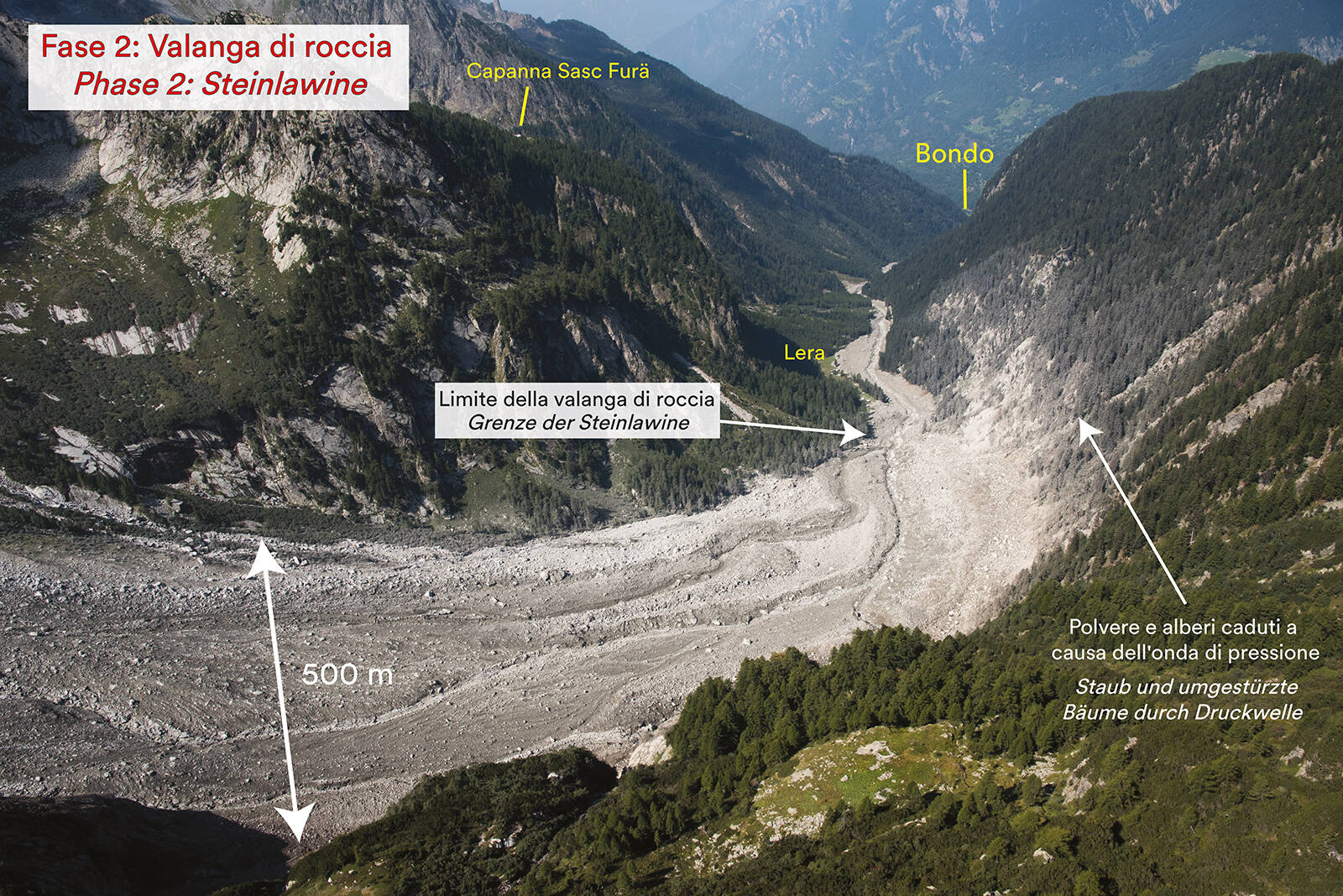
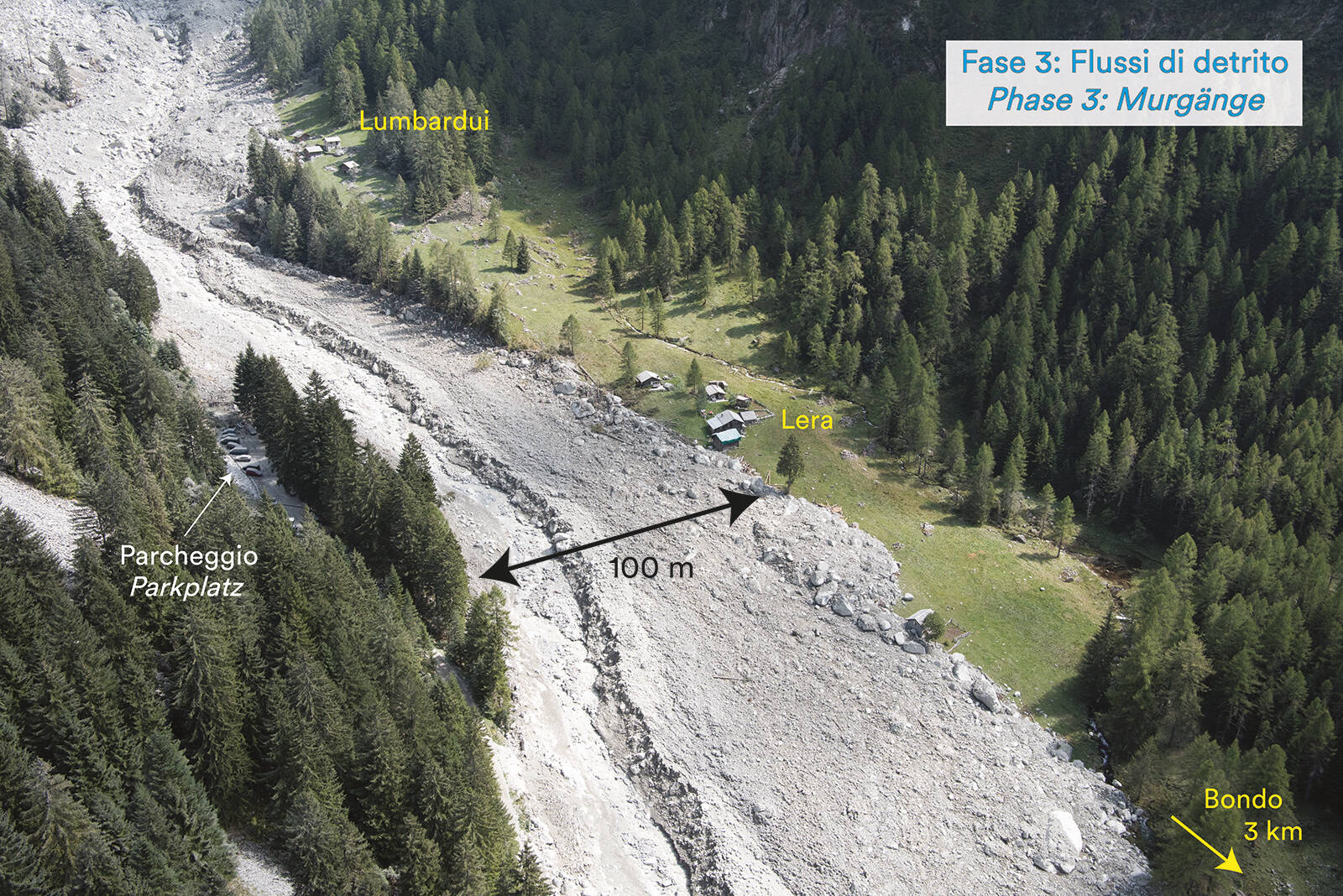
The 2017 Pizzo Cengalo–Bondo rockfall
On the 23rd of August 2017, one of the largest and most devastating rockfalls in recent memory occurred on Pizzo Cengalo at the head of the Bondasca Valley. This resulted in the tragic loss of eight lives and significant destruction in the village of Bondo. At 09:30, approximately three million cubic metres of rock detached from the north-eastern face of the mountain and collapsed onto a small glacier below (phase 1). Initially, the relatively dry mass surged three kilometres down the valley as a rock avalanche, reaching speeds of up to 200 km/h (phase 2 and photo). However, due to the incorporation of water from the glacier and from saturated valley sediments, the mass then turned into a mobile debris flow, reaching Bondo at 9:45 am (phase 3 and photo). Many more debris flows occurred over the following hours and days, ultimately filling the artificial retention basin in Bondo and spilling over into the village and across the main road. Eight years later, the engineering projects to build a larger retention basin and reopen the hydroelectric dam in the Bondasca Valley were completed, and new hiking trails were constructed to access the Sciora and Sasc Furä mountain huts.
Sources:
Apuani, T. & Scapozza, C. (2023) AMALPI TREK – Dal Maloja al Gottardo: Alpi in Movimento, Movimento nelle Alpi. Milano, Milano University Press, pp. 176, doi: 10.54103/milanoup.141
Mergilli, M. et al. (2020) Back calculation of the 2017 Piz Cengalo-Bondo landslide cascade with r.avaflow: what we can do and what we can learn. Natural Hazards Earth System Science, 20, 505-520
Walter, F. et al. (2020) Direct observations of a three million cubic meter rock-slope collapse with almost immediate initiation of ensuing debris flows. Geomorphology, 351, 106933
Wilhelm et al. (2019) Bergsturz Cengalo und Murgänge Bondo: Erfahrungen der
kantonalen Fachstelle. Forum für Wissen, WSL Berichte, Heft 78, 53-66