


Geology Bregaglia - Durbegia
Masters of stone: geology and community in Bregaglia
The geology and geography of mountainous regions such as Bregaglia have a profound influence on the economic, cultural and artistic heritage, while also presenting challenges in the form of natural hazards. The following examples illustrate the close relationship between the availability of natural materials, such as rocks and minerals, and their utilisation in Bregaglia.
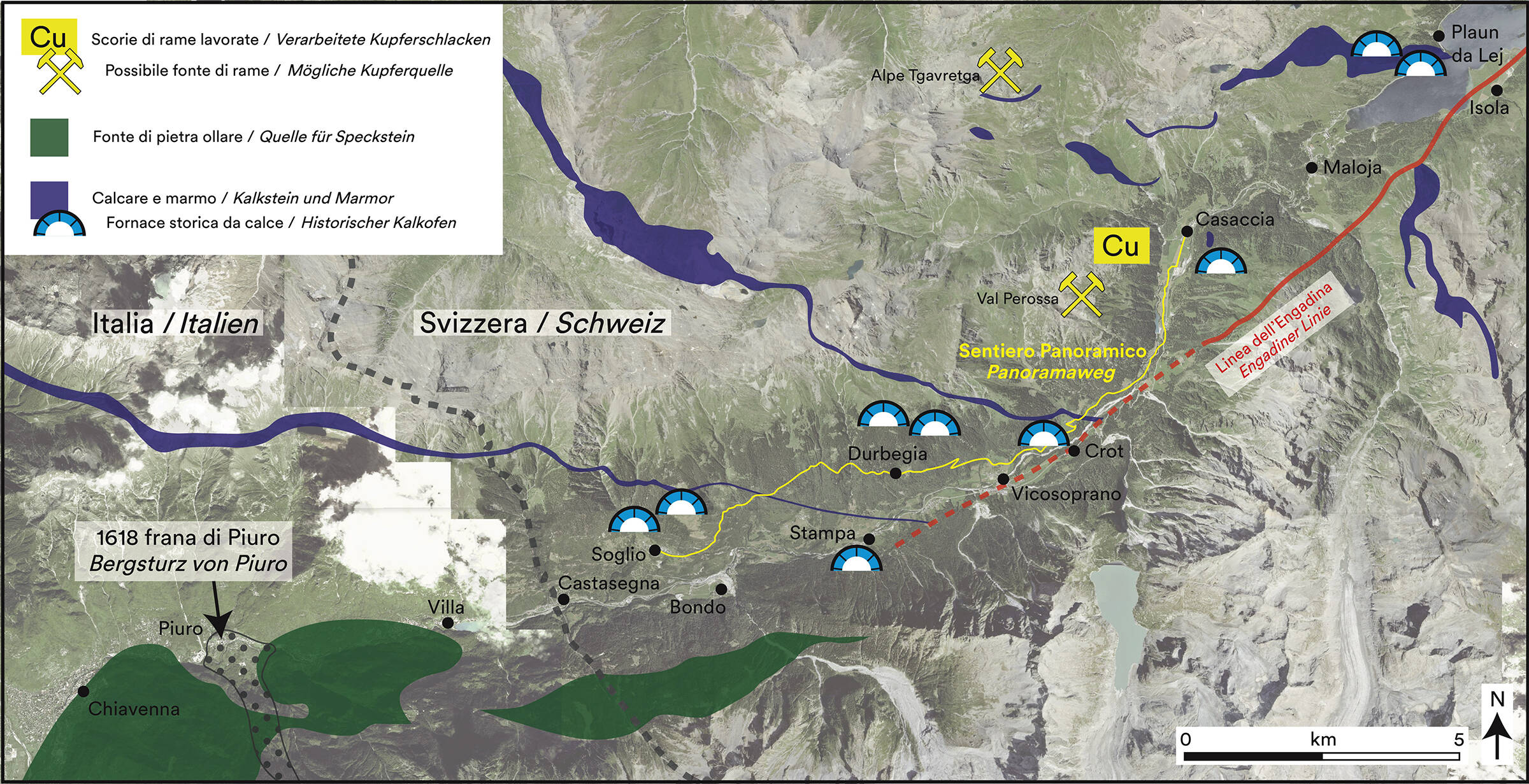
The map shows the locations of historic lime kilns and prehistoric copper slag deposits. Blue areas indicate where limestone and marble are found on the surface and were mined for combustion in lime kilns. Green areas indicate where rocks were extensively mined for soapstone.
Late Bronze Age copper smelting
Evidence of copper smelting in the Late Bronze Age (c. 1550–1200 BC) can be found on a hill overlooking the village of Casaccia, where small pieces of copper slag were excavated in the 1970s. The copper was probably sourced from the minerals chalcopyrite (CuFeS2) and malachite (Cu2(CO3)(OH)2), which can be found in rocks nearby (for example in Val Perossa or near Alp Tgavretga). Pieces of these rocks may have been transported to Casaccia and processed in small furnaces using charcoal from local trees as fuel.
Extraction and carving of soapstone
Soapstone, known locally as pietra ollare or lavez, is a compact green rock made from the minerals olivine and talc. The rock originally comes from deep within the Earth’s mantle but is sometimes thrust upwards to the surface by great tectonic forces. This occurred near Chiavenna and Piuro, where a large area of mantle rock containing soapstone was extensively mined to produce cooking pots, statues and architectural stone. Mining began in prehistoric times and continued vigorously into the Middle Ages, bringing great wealth and prosperity to the region. However, on 4th September 1618, the rock that had previously been a blessing turned into a nightmare when the mountain south of Piuro, weakened by centuries of mining, collapsed onto the village, killing most of its inhabitants.
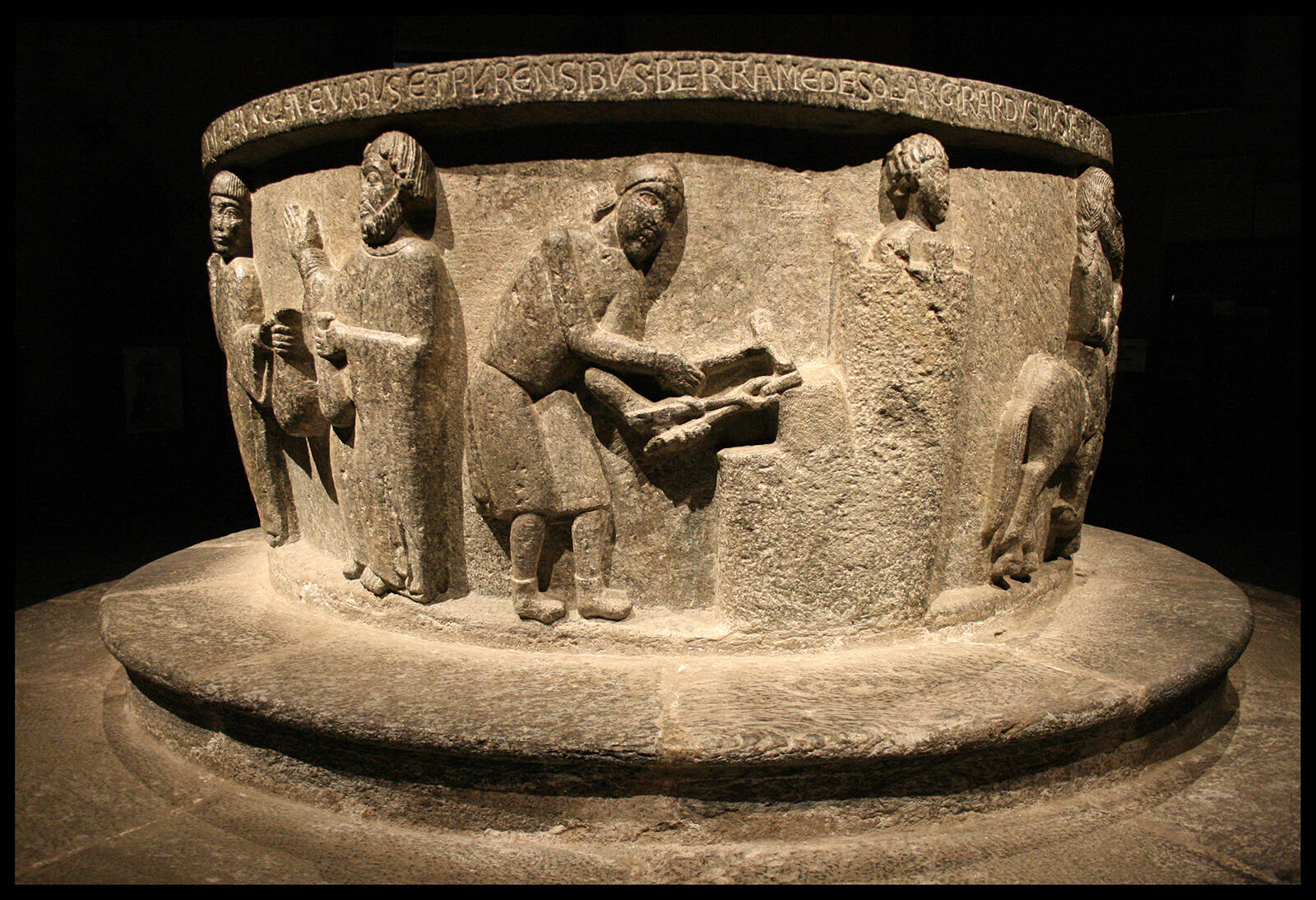
The fonte battesimale (baptismal bath) was commissioned in 1156 and is made from a single block of soapstone. The circular bath has a circumference of six metres and is on display in the Museo del Tesoro (Museum of Treasures) in Chiavenna. Photo: Museo del Tesoro, Chiavenna.
Historical lime kilns
There are many historical lime kilns in Bregaglia, including accessible examples in the valley (e.g., Crot and Plaun da Lej) and smaller, more remote ones on higher pastures (e.g., Tombal, Plän Vest, Castell, Zocheta). These structures were used mainly in the 18th-20th Centuries to bake limestone and marble (CaCO3) at temperatures of 900-1100°C, producing calcium oxide (lime, CaO) and CO2. Adding water to lime produces calcium hydroxide (slaked lime), which is a cement-like material widely used in construction. The limestone and marble come from thin layers of rock that formed deep in the ocean around 200 million years ago. The kilns are usually located quite close to these layers to facilitate easier transportation of the rock pieces.
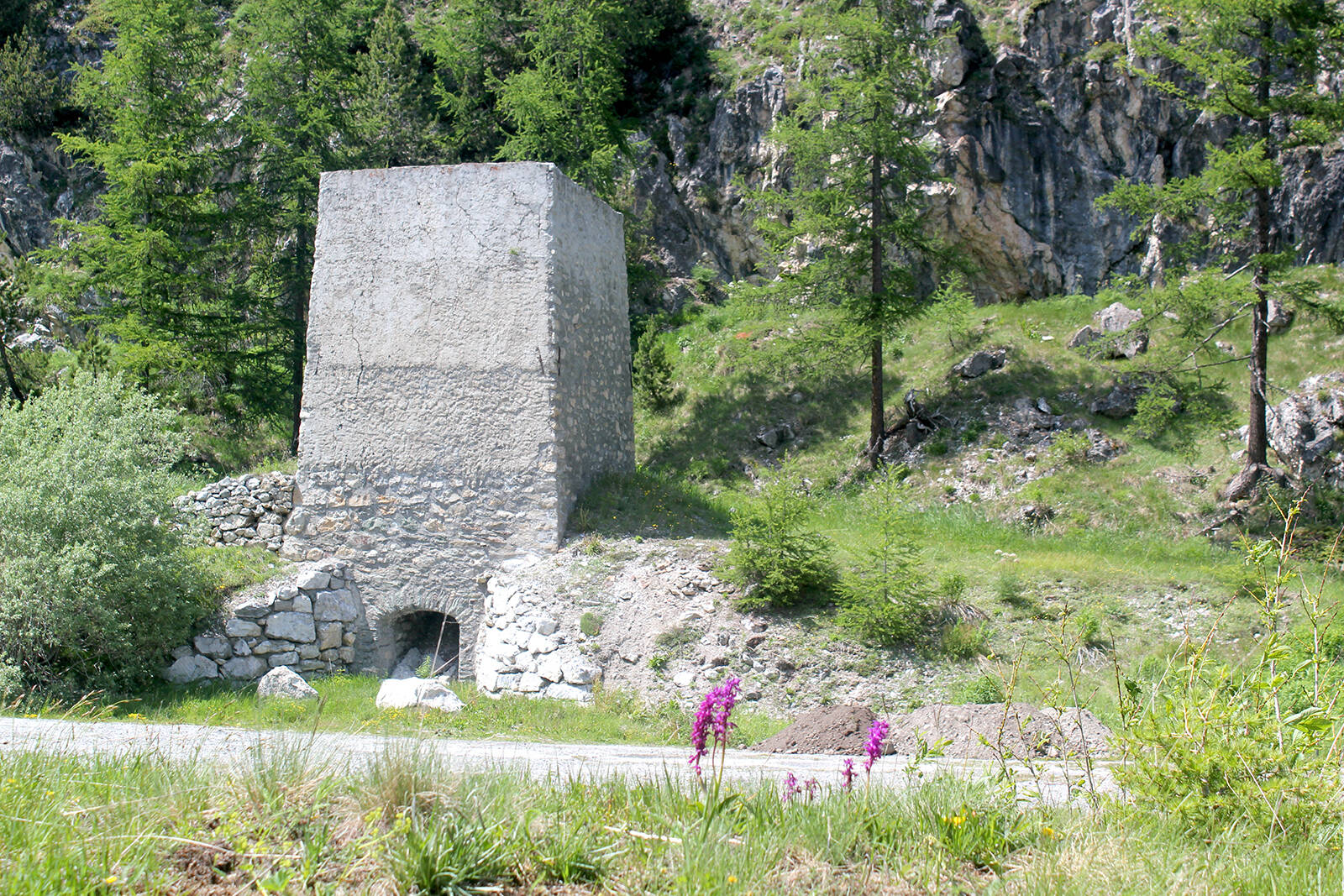
Large lime kiln next to the cantonal road near Plaun da Lej. In the background are cliffs made from limestone and marble. Photo: Steven Smith.
Sources:
Apuani, T. & Scapozza, C. (2023) AMALPI TREK – Dal Maloja al Gottardo: Alpi in Movimento, Movimento nelle Alpi. Milano, Milano University Press, pp. 176, doi: 10.54103/milanoup.141
Maurizio, R (1972) Indagini su Vecchie Cave e Miniere in Bregaglia. Quaderni Grigionitaliani, 41, 1-71
Wenk, H-R et al., (2020) Slags as Evidence for Copper Mining above Casaccia, Val Bregaglia (Central Alps). Minerals, 9, 292; doi.org/10.3390/min9050292
Wenk, H-R & Wenk, E. (2023) Discovering the Unique Geology of the Bergell Alps. GeoGuide, Springer, https://doi.org/10.1007/978-3-031-30738-6
Swisstopo